
Where Did My Energy Go?
Have you ever caught yourself saying:
"I used to be able to do all of this without feeling exhausted."
Maybe you remember a time when you could work all day, exercise in the evening, stay up late, and still feel ready to go the next morning.
Then life happened.
You got married. Had kids. Advanced in your career. Started caring for aging parents. Dealt with injuries, health concerns, stress, or poor sleep.
Suddenly, the energy you once took for granted feels like a much more limited resource.
Understanding Your Daily "Spoons"
Have you heard of the Spoon Theory?
It was originally developed by people living with chronic illnesses such as Multiple Sclerosis (MS) to help explain what daily energy feels like.
The idea is simple:
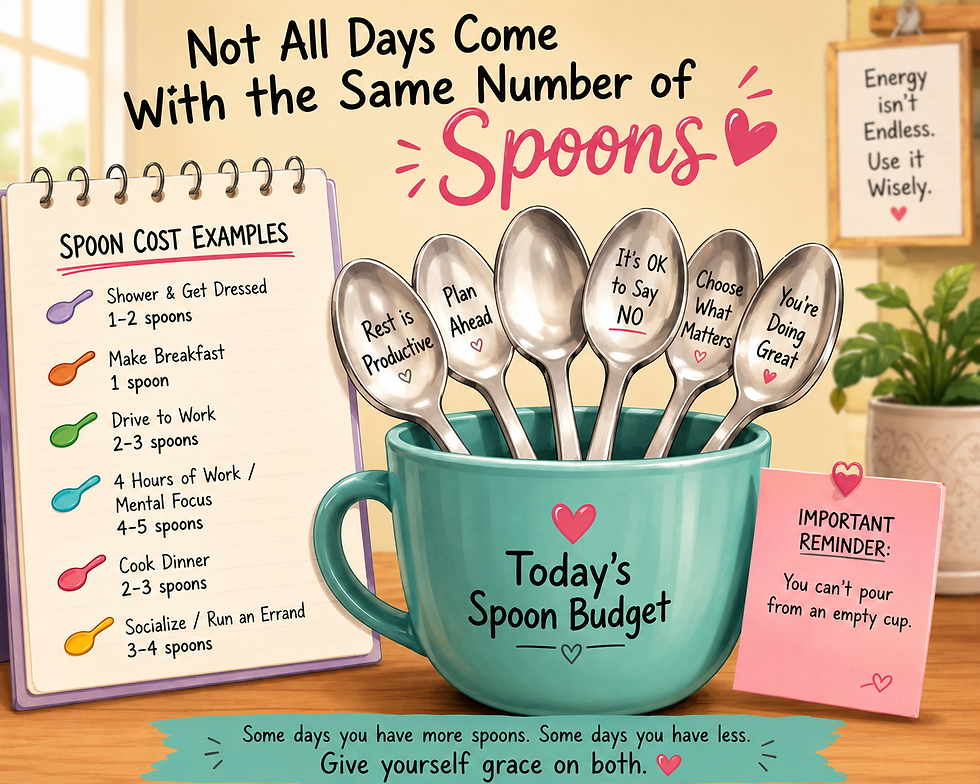
Each day you wake up with a certain number of spoons. Each spoon represents a unit of energy.
Getting dressed might cost a spoon.
Making breakfast might cost a spoon.
Driving to work might cost two spoons.
A stressful meeting? Maybe another spoon.
Cooking dinner, helping with homework, running errands, attending a social event... more spoons.
Unlike money, you don't get to choose how many spoons you start with. Some days you wake up with plenty. Other days, not so much.
While Spoon Theory was created to explain life with chronic illness, I think many of us can relate to it as we get older.

The Spoon Budget Changes
When I was younger, I seemed to have an endless supply of spoons.
Or at least it felt that way.
What I could do in my twenties is not the same as what I can do now.
What I could do before kids is different than after kids.
One child changed things.
Two children changed things again.
Add a busy career, volunteer commitments, aging parents, household responsibilities, and life's unexpected challenges, and suddenly those spoons disappear quickly.
Maybe you're caring for a child with health concerns.
Maybe your spouse is struggling.
Maybe you're dealing with your own health challenges, chronic pain, sore joints, poor sleep, or increased stress.
Every one of these factors uses energy.
Every one of these factors costs spoons.
The Problem Isn't That You're Lazy
This is an important point.
Many people blame themselves when they don't have the energy they once did.
They tell themselves they need more willpower.
More motivation.
More discipline.
But often the problem isn't a lack of effort.
The problem is that the demands on your life have increased while your available energy has decreased.
You're trying to fit twenty spoons worth of responsibilities into a day that only has twelve spoons available.
That's a recipe for frustration.
Borrowing From Tomorrow
One of the most powerful parts of Spoon Theory is the concept of borrowing spoons from tomorrow.
We've all done it.
We stay up late to finish a project.
We push through exhaustion to attend another event.
We skip recovery.
We ignore our body's signals.
And sometimes that's necessary.
But if it becomes our normal way of operating, tomorrow eventually sends us the bill.
The result?
More fatigue.
Less patience.
Poor food choices.
Skipped workouts.
More aches and pains.
Less resilience.
Many people feel trapped in this cycle because they are constantly spending tomorrow's energy today.
Why Health Changes Feel So Hard
This is something I discuss with clients regularly.
Improving your health isn't just about adding a workout or eating more vegetables.
It often requires changing habits, routines, environments, and expectations.
The challenge is that change itself requires energy.
If your spoons are already fully spent every day, it becomes very difficult to create new habits.
That's why trying to simply "work harder" usually doesn't work.
We need a better strategy.

Make Better Use of Your Spoons
Sometimes the answer isn't finding more energy.
Sometimes it's using the energy you have more intentionally.
This might mean:
Meal planning so you're not making food decisions when exhausted.
Preparing lunches ahead of time.
Going to bed earlier.
Scheduling workouts at a time when your energy is highest.
Asking for help.
Simplifying commitments.
Creating routines that reduce decision fatigue.
A little preparation today can save several spoons tomorrow.
Learning to Say No
This is often the hardest part.
Many of us try to say yes to everything.
We want to help.
We don't want to disappoint people.
We feel guilty setting boundaries.
But every yes costs a spoon.
And sometimes the only way to say yes to the things that truly matter is to say no to things that don't.
Saying no to one commitment might allow you to:
Exercise consistently.
Prepare healthier meals.
Get more sleep.
Spend quality time with your family.
Manage your stress better.
That's not selfish.
That's stewardship of your energy.
A Different Question
Instead of asking:
"Why can't I do what I used to do?"
Try asking:
"Given the spoons I have available today, what's the most important thing I can do with them?"
That shift changes everything.
Because health isn't about pretending you're twenty years younger than you are.
It's about recognizing the reality of your current season of life and making the best use of the resources available to you.
Your energy may not be unlimited anymore.
Mine isn't either.
But when we learn to manage our spoons wisely, we often discover we have enough energy for the things that matter most.
And that's a pretty good place to start.


Comments